

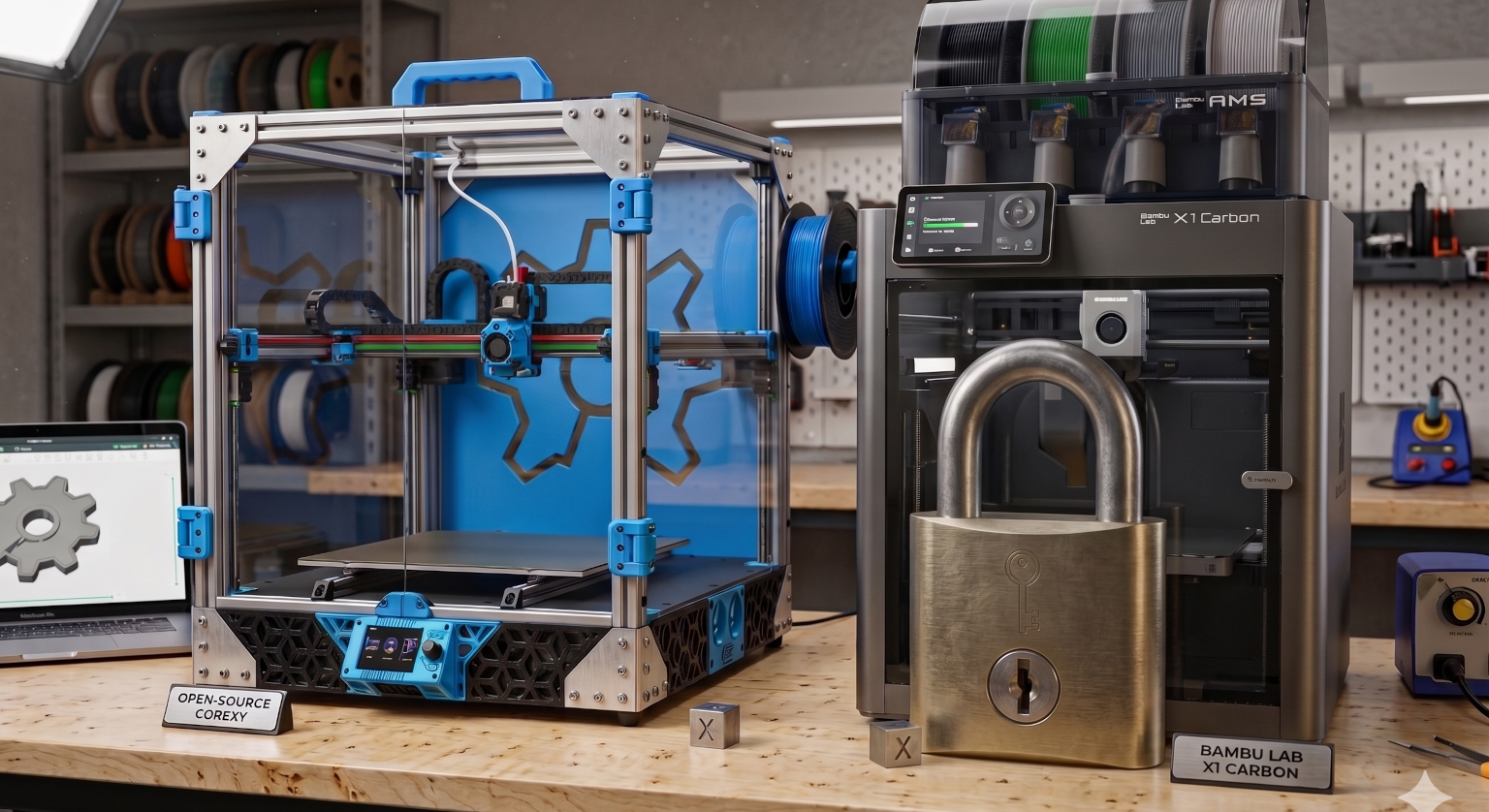
The 3D printing community has always thrived on one golden rule: collaboration. It was the Open Source culture that transformed fragile, experimental machines into the robust prototyping tools we use today. Without the work of thousands of community developers, today’s corporate giants wouldn’t have a foundation to build their empires.
Bambu Lab is a prime example of this dynamic. They make fantastic machines and have undeniably shifted the consumer market. However, their core software, Bambu Studio, didn’t start from scratch. It is a fork of PrusaSlicer, which evolved from Slic3r. This code is protected by the AGPL (Affero General Public License)—a “copyleft” license designed to prevent corporate monopolies by requiring those who use open code to keep their modifications equally open and free.
But what happens when a company uses that community “golden ticket” and then decides to lock the door behind them? The recent conflict between Bambu Lab and independent developer Pawel Jarczak gives us the answer—and it’s a red flag for the entire Maker Movement.
The Lockdown: The Death of Interoperability
If you haven’t followed the latest news, here is the breakdown:
- The Slicer War: For a long time, the community used OrcaSlicer (a popular independent fork of Bambu Studio) to control their machines with more freedom and advanced features.
- Walled Gardens: Under the guise of “security”—and to force users through their Cloud system and Bambu Connect app—Bambu Lab implemented an authorization control that cut off OrcaSlicer’s direct access to the machine’s functions.
- The Legal Threat: Pawel Jarczak created a GitHub project to restore this direct access using public code. Bambu Lab responded with a Cease-and-Desist letter, threatening the developer with heavy legal action and accusations of reverse engineering.
Without the resources to fight a multinational in court, Pawel was forced to delete his code. The message was clear: “You own the hardware, but you only use it our way.”
Corporate Hypocrisy and the AGPL
The irony is deep. Bambu Lab built its platform on Open Source foundations. By legally threatening a developer who is simply modifying code (a right guaranteed by the AGPL license itself), they are betraying the community that made their success possible.
As Right to Repair advocates like Louis Rossmann point out, you cannot use community-driven tools to build a system and then use legal weight to stop that same community from building on top of your (their) work. This “walled garden” approach tries to turn a hardware purchase into a forced service subscription.
Why My Machines Supports Klipper and the Free Ecosystem
At My Machines, we believe technology should serve the user, not the other way around. This is why we avoid “black boxes” in Digital Fabrication:
- You Are the Owner: When you buy a machine, the hardware, firmware, and configurations belong to you.
- Klipper = Freedom: By using Klipper firmware, we ensure you are never locked into a closed ecosystem. Want to use FreeCAD? Perfect. Prefer OrcaSlicer? Go for it.
- Progress Depends on Open Source: We don’t threaten those who improve our systems; we celebrate them.
The Bambu Lab case is a serious reminder: the convenience of a closed ecosystem today is your technical prison tomorrow. Real innovation in Maker Education and DIY fabrication happens when files are open, documentation is clear, and tools have no invisible chains.
If you’re tired of updates that remove features you already paid for, join the Open Source revolution. Your machine. Your rules.