
The rise of desktop 3D printing often draws comparisons to the “MP3 moment” of the early 2000s. Just as Napster and the iPod transformed the music industry, 3D printing is challenging our understanding of physical objects, patents, and copyright. But is this a crisis or an opportunity for the Maker community?
At My Machines, we believe that understanding the legal landscape is as important as mastering your FreeCAD constraints. Let’s dive into how the law sees your DIY projects and why the Open Source philosophy is the best path forward.
1. Functional vs. Decorative: The Great Legal Divide
One of the most important distinctions in intellectual property (IP) law is whether an object is functional or artistic.
- Copyright: Generally protects creative works (sculptures, jewelry, decorative vases). Protection is automatic.
- Patents: Protect functional items (hinges, gears, mechanical assemblies). Unlike copyright, you must explicitly apply for a patent.
- The “Maker” Reality: Most parts we print for our CNCs or printers are functional. This means they often fall outside the scope of copyright, but could potentially infringe on a patent if one exists.
2. The “MP3 of Objects”: Learning from History
When digital music arrived, the industry reacted by suing customers and creating restrictive DRM (Digital Rights Management). It didn’t work.
- Suing doesn’t stop innovation: Alienating the community only drives development underground.
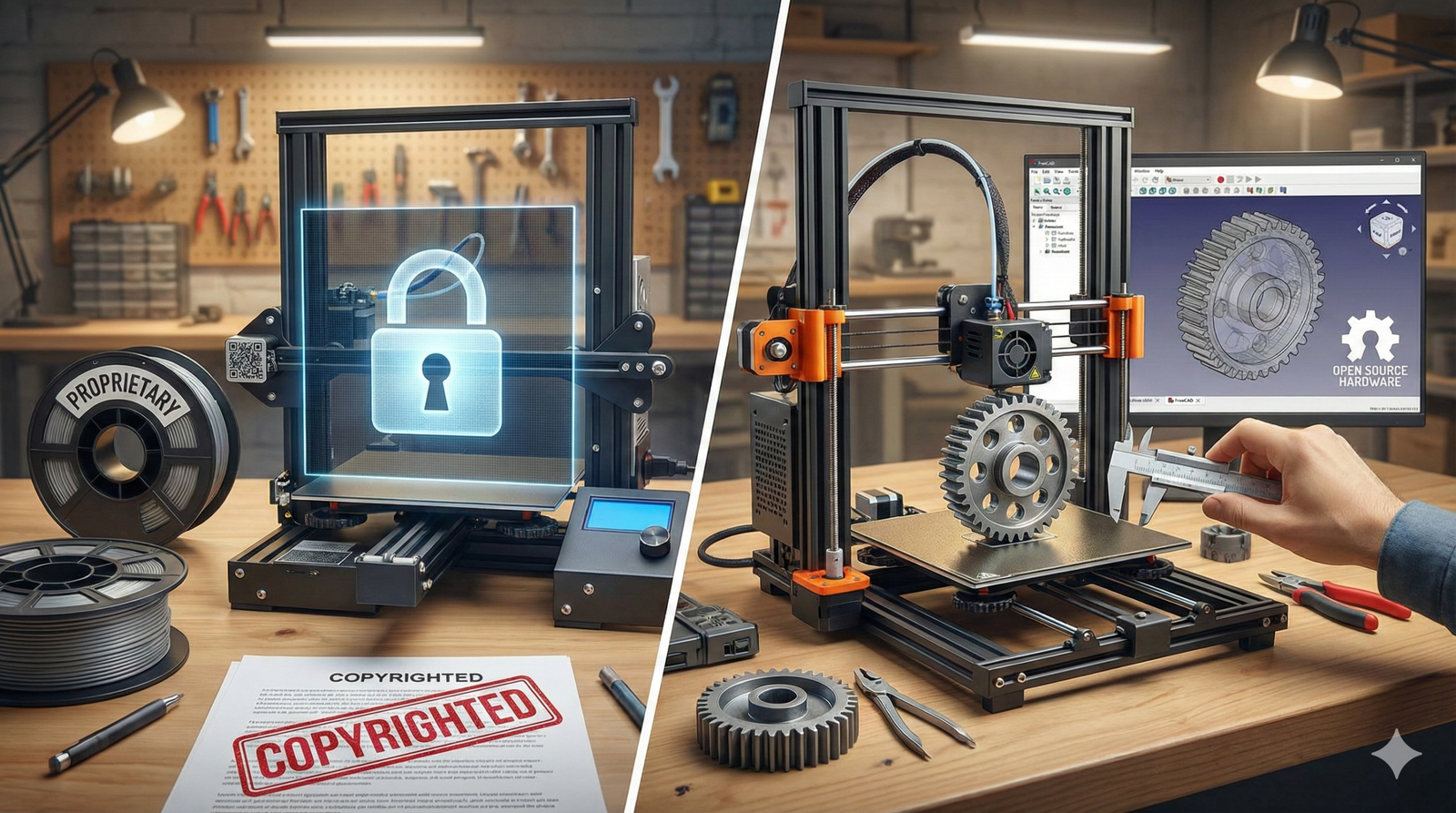
- DRM is a “Cockamamy Scheme”: Trying to “lock” 3D printer firmware to only print verified files or use specific filaments (like some manufacturers attempt) usually fails because the community finds a way around it.
- Value over Restriction: The real solution is providing value. People pay for convenience, quality documentation, and verified files.
3. Verification vs. Control
Instead of DRM that stops you from printing, the future lies in Digital Verification.
- Trust the Source: Imagine being at a remote airfield and needing a critical part for your plane. You don’t want a “pirated” file; you want a verified file from the manufacturer, checked via a digital signature (check-sum) to ensure it was calibrated for your specific machine.
- Authenticity for Artists: For Maker-artists, verification allows them to sell “limited editions” where the value is in the digital certificate of authenticity, even if the file itself is shared.
4. Community Norms: We Are the Judges
The law is often slow to catch up with technology. When cases eventually reach a judge, they often look at Community Norms.
- Our Responsibility: The way we share, credit, and commercialize Open Source designs today sets the precedent for tomorrow’s laws.
- The My Machines Approach: We prioritize Open Source not just because it’s free, but because it’s transparent. By providing detailed documentation and centralized knowledge, we solve the “complexity pain” without needing to lock down our IP.
SolidWorks (Industrial) vs. FreeCAD (Accessible) in the IP World
In an industrial setting (SolidWorks), IP is often guarded by high walls and expensive licenses. In the Maker world (FreeCAD), we leverage the power of the community.
- SolidWorks: Best for internal corporate R&D where patent protection is the primary goal.
- FreeCAD: The ultimate tool for Open Source fabrication. It allows you to create parametric models that others can learn from, modify, and improve, fostering a “Standard of Mastery” rather than a “Standard of Secrecy.”
Conclusion: Forge Your Own Standard
3D printing won’t “break” copyright, but it will force it to evolve. As makers, our goal shouldn’t be to bypass the law, but to build a better system based on Open Source Fabrication and Maker Education.
What’s your take on IP in 3D printing? Have you ever encountered a “locked” machine or a file that felt “pirated”? Let’s discuss how we can build a smarter, more open community together.