
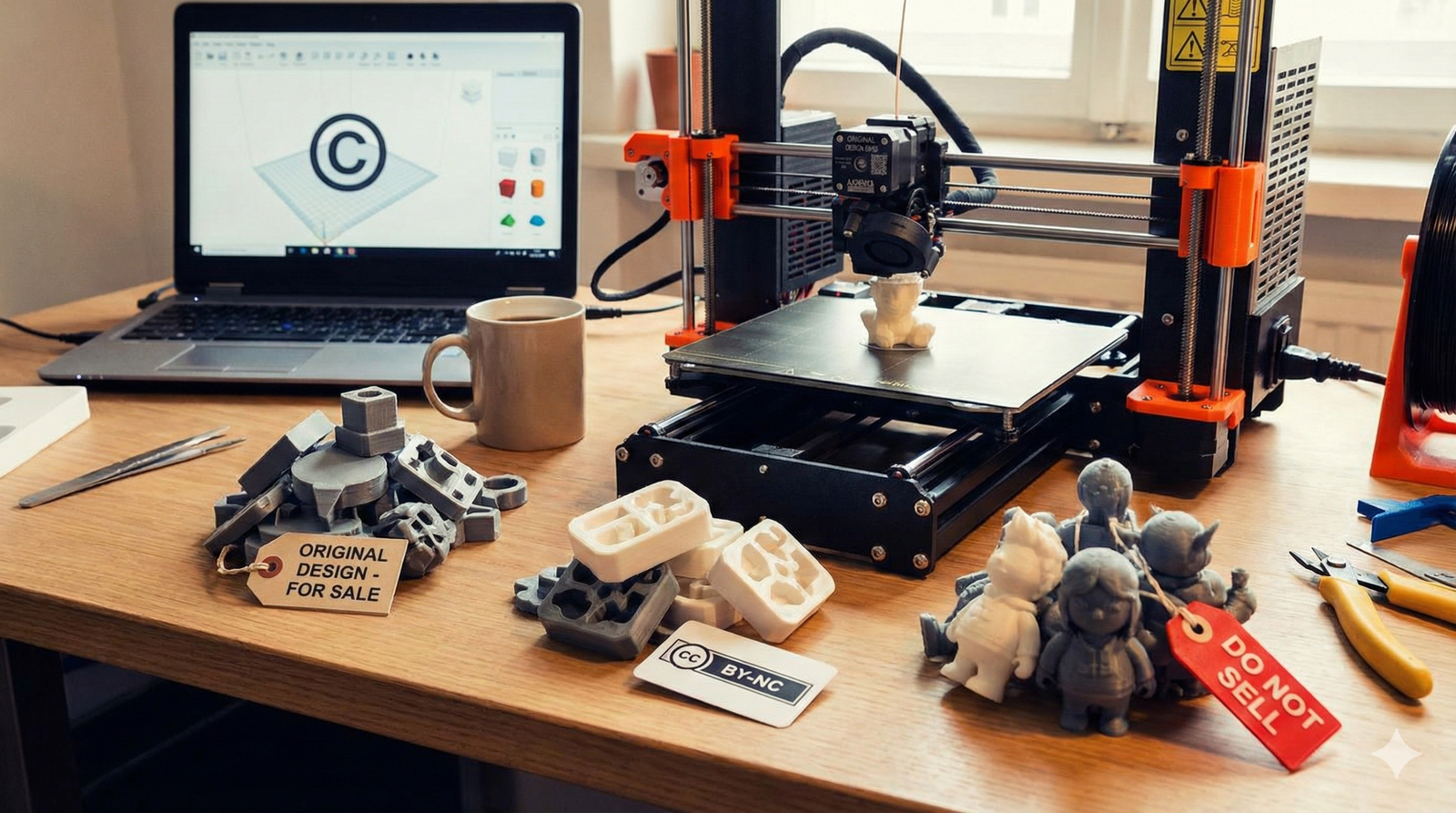
So, you’ve mastered your Open Source 3D printer, your prints are looking sharp, and you’re starting to see dollar signs. The big question is: Can you legally sell 3D prints?
In the world of DIY and Digital Fabrication, the line between a hobby and a business often gets blurred by copyright and licenses. Let’s break down what you need to know to stay safe and ethical.
1. Selling as a Service (The “Employee” Model)
The simplest way to make money is by offering a printing service.
- How it works: A customer brings you an STL file, and you charge for the machine time, material, and labor.
- Liability: In this scenario, you are essentially an “employee” for the duration of the job. Most of the legal responsibility regarding the file’s copyright falls on the customer.
- Consultant Tip: While you aren’t a lawyer, it’s good practice to refuse prints that are obviously illegal or dangerous. “The less you know, the less you’re liable,” but common sense is your best friend here.
2. Selling Your Original Designs
This is the gold standard for any Maker. If you designed the model from scratch in FreeCAD or SolidWorks, you own the rights.
- Full Control: You decide if you want to sell the physical prints, the digital files, or both.
- The “Fan Art” Trap: Be careful! Even if you modeled a character yourself from scratch, if it’s based on someone else’s intellectual property (like a famous movie character), you don’t have full ownership. The original IP holder still has a claim.
3. Selling Other People’s Designs (Creative Commons)
Most makers find cool models online (Thingiverse, Printables, etc.) and want to sell them. This is where Creative Commons (CC) licenses come in.
- Attribution (CC BY): You must give credit to the original creator. A good way to do this is by attaching a small card or a QR code to the print linking back to the source.
- Non-Commercial (NC): This is the “Stop” sign. If a model has an NC tag, the creator says “No selling.”
- The Workaround: Don’t just ignore it! Contact the creator. Many are happy to grant a commercial license in exchange for a small fee, a donation, or a Patreon subscription.
4. Myths to Avoid: The “20% Rule”
You might hear people say, “If I change 20% of the model, it becomes mine.” This is a myth.
- There is no magic percentage that makes a derivative work legal. If the original work is still recognizable, the original creator still holds rights over that portion of the design.
- Moving a design from a digital medium to a physical one (3D printing it) is not “transformative” in a legal sense—it’s just a change of medium.
5. Why Ethics Matter in Maker Education
At My Machines, we believe in democratizing technology through Open Source Fabrication. Respecting licenses isn’t just about avoiding “punitive damages” (which can be terrifyingly high); it’s about supporting the ecosystem.
- If you find a model with no license listed, ask the author.
- If you get a “Cease and Desist” message, take it seriously and be contrite. It means you’ve been noticed, and it’s time to back off.
Conclusion: Keep it Safe, Keep it Maker
Can you sell 3D prints? Yes. But do it the right way:
- Prioritize your own original designs.
- Respect the CC licenses of the community.
- Communicate with other creators.
Turning your passion into a business is part of the Maker journey. Do it with respect for the craft and the laws that protect creativity!